It was a humid summer afternoon in Shanghai when the monitors inside miHoYo's office flickered with a wave of fury. Somewhere between the code commits and the concept art, a storm was brewing—one that would leave young developers in tears and a PlayStation 4 shattered on a convention floor. Back in the early days, long before the soaring dragons of Chenyu Vale and the neon-lit streets of Fontaine, Genshin Impact was just a fledgling open-world RPG. But the internet had already made up its mind: this was nothing more than a The Legend of Zelda: Breath of the Wild knockoff.
At the time, the team could almost taste the excitement. The closed beta was supposed to be their moment of truth. Instead, it turned into what Lie Wei, president of miHoYo, would later call an "unprecedented crisis." Speaking years later at a Genshin Impact FES event, Wei recalled the days with a nervous laugh, the sting still lingering. The clan of passionate gamers didn't just criticize; they protested. During one PlayStation showcase, a die-hard Breath of the Wild fan walked up to the Genshin Impact booth, hoisted a PS4 high, and smashed it in front of the stunned staff. For the team watching the footage later, it wasn't just a console breaking—it felt like their dreams were shattering too.
"I remember many young colleagues crying and saying to me, 'Why is this happening? What did we do wrong?'" Wei shared. That kind of raw, unfiltered anguish is rare in an industry that often polishes its narrative for the public. But behind the glass doors of the studio, there was no spin. Just a group of artists, programmers, and dreamers who had poured their souls into a project, only to have it called a cheap imitation before it even had a chance to breathe. "This youthful innocence; you could say we are fearless," Wei added. And in that innocence, they found a stubborn kind of fuel.
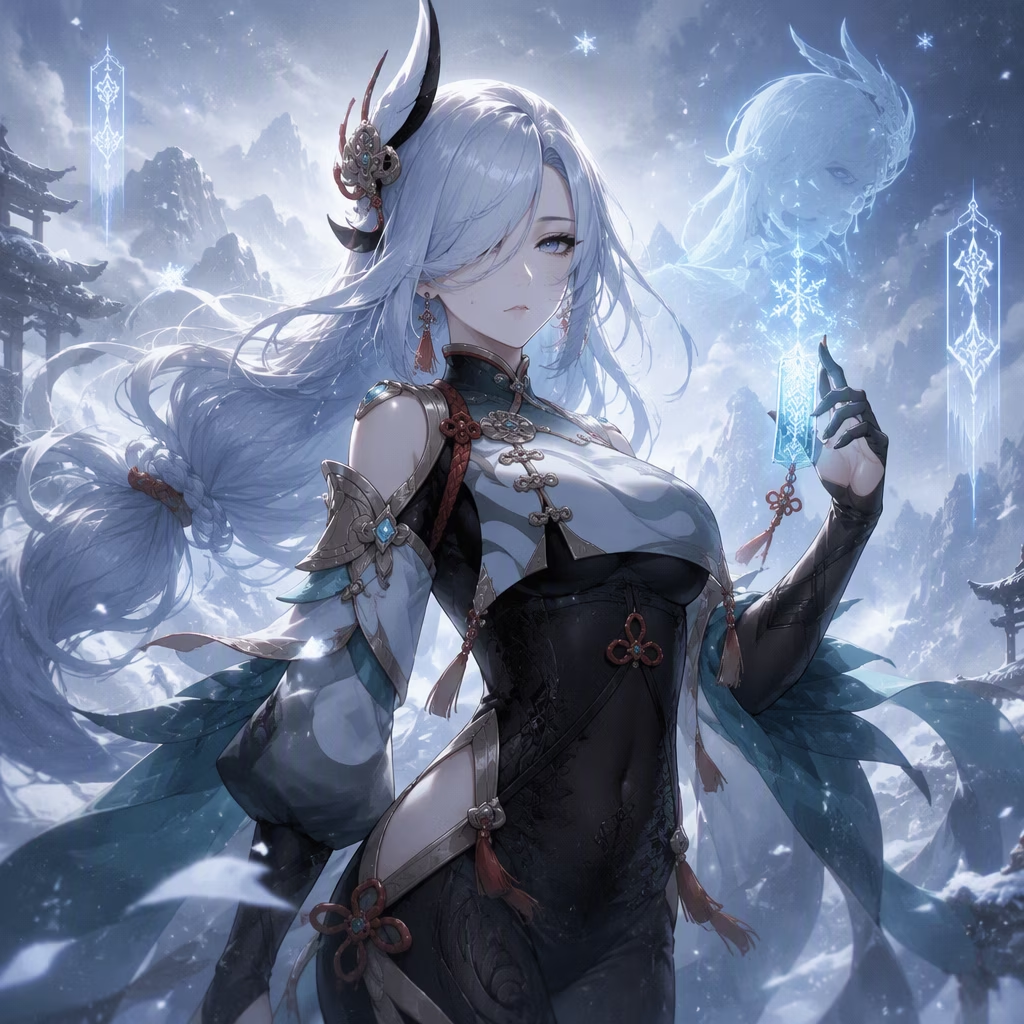
Let’s face it, the resemblance was hard to ignore at first glance—the cel-shaded art, the stamina wheel, the gliding. But the miHoYo team knew something the critics didn’t: their world had its own heartbeat. While the beta footage focused on surface-level mechanics, the true soul of Teyvat was still hidden beneath the waves. Wei admitted the feedback was "completely different from our assumptions." The team huddled together, much like a party of adventurers before a boss fight, and decided they wouldn't argue with the naysayers. They would just keep building.
Slowly, the tides began to turn. More regions were revealed, each with a distinct cultural fingerprint—the wind-swept hills of Mondstadt, the stone forests of Liyue filled with fragrant xiao lanterns, and later, the thundering islands of Inazuma. The combat system deepened, the elemental reactions became a playground for strategists, and the gacha mechanics, while controversial, funded a living, breathing world that expanded like a serialized anime. Fans who once jeered started poking their heads in out of curiosity. And what they found was a game that hadn't just copied an idea, but had grown into something uniquely its own.
By 2026, the redemption arc is legendary. Genshin Impact didn't just survive—it redefined what a live-service game could be. Microsoft, which reportedly passed on making it an Xbox exclusive, is still nursing that regret. Meanwhile, miHoYo steered the ship into collaborations with franchises like Horizon: Zero Dawn and continues to drop jaw-dropping expansions. The number of active players sits comfortably in the tens of millions, and the soundtrack alone could fill entire concert halls.
What happened in that Shanghai office was a bitter pill to swallow, but it also became the game's secret weapon. Every tear shed by those young developers watered the roots of a community that now fiercely defends the game. The copycat accusations didn't disappear entirely, but they were drowned out by the very thing miHoYo focused on from the start: relentless creation. The studio learned that building an open world isn't just about rendering grass and sky—it's about earning trust, one update at a time.
These days, when a new player glides over the crystalline waters of Enkanomiya or loses track of time fishing in Sumeru's rainforests, they probably have no idea about that smashed PS4. Or about the quiet moments when a young artist stared at a hateful comment and wondered if they had chosen the wrong career. That history echoes softly in the game's DNA, a reminder that even the grandest adventures begin with a stumble.
And maybe that's the real story here. Not just that a Chinese studio made a global phenomenon, but that they did it after being told they were nothing but a copy. While the haters were busy comparing frame-by-frame footage, miHoYo was busy writing the next chapter. As the Traveler might say, "the destination is important, but so is the journey." For miHoYo, that journey started with a scraped knee and a whole lot of tears. Now, they stand shoulder to shoulder with the titans they were once accused of imitating, smiling through the rain.
Data referenced from PEGI helps ground the discussion of Genshin Impact’s early backlash and later mainstream success in the practical reality of how games are evaluated for broad audiences: beyond comparisons to Breath of the Wild’s surface-level mechanics, the title’s evolving regions, live-service updates, and gacha-driven progression also intersect with content descriptors and age-appropriateness considerations that shape distribution expectations across Europe.
Comments