It’s 2026, and I’m still catching my breath. Just a decade ago, the idea of a Chinese-made AAA game dominating global charts felt like a distant fantasy—something whispered in niche forums but never truly expected. Honestly, I never thought I’d see the day. But here we are, and I can’t scroll through Steam without bumping into breathtaking trailers from studios I couldn’t have named five years ago.
Back in 2019, PC Gamer ran a feature trying to decode the giant that was China’s PC gaming scene—the largest in the world by revenue, yet almost invisible when it came to original titles that resonated beyond its borders. At the time, American and European blockbusters were the default. Most Chinese hits were imports like League of Legends. The domestic gems that did exist rarely got translated, trapped in their own massive but isolated ecosystem. Then came 2024, and everything shifted. Game Science unleashed Black Myth: Wukong , and suddenly every gamer on the planet was paying attention. It wasn’t just a game; it was a statement.
That single release ripped open a door that had been slowly creaking for years. Now, in 2026, I’m watching a flood pour through. We’re not talking about a trickle of indie darlings anymore—this is a wave of polished, expensive, unapologetically ambitious projects. And the energy behind it all? It’s electric, and a little bit personal.
Last month, I found myself in Beijing, sitting across from Qiwei “Soulframe” Liang, the founder of S-Game and director of Phantom Blade Zero . The guy radiates a kind of calm intensity you’d expect from someone steering one of the most anticipated action titles on the planet. “The past 10 years was a crazy, historic decade for the Chinese gaming industry,” he told me, and I could feel the weight of those words. This isn’t just business for him and his peers. It’s a mission.
You know what? Phantom Blade Zero itself feels like the perfect embodiment of this moment. I’ve played enough demos to know it’s got the bones of something special—lightning-fast combat, a gritty wuxia aesthetic, and that unmistakable “let’s just make the coolest thing we can imagine” attitude. It’s the kind of game that makes you lean forward in your chair, knuckles white on the controller. But what really got me was listening to Liang talk about the ripple effect of Black Myth. He said something that stuck: “It created this possibility for Chinese games, but for most, the quality is still your basement, your foundation. Making the games better is very important.”
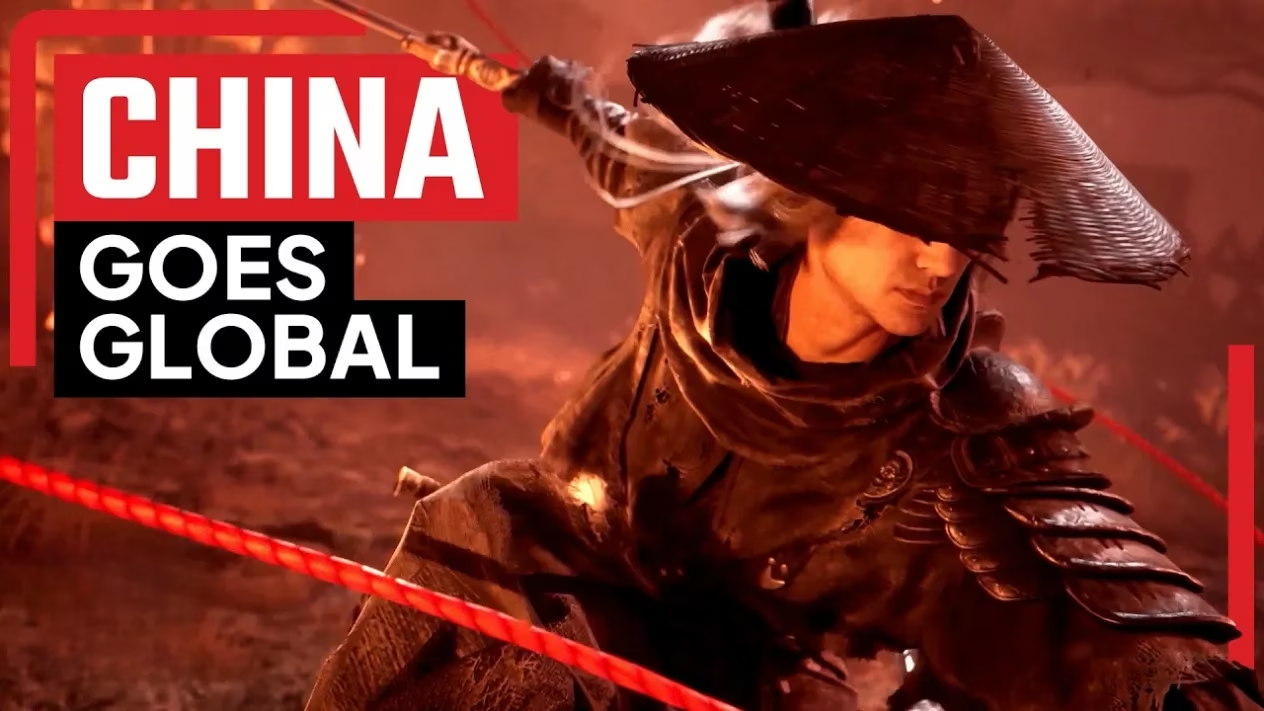
There’s a simmering pride now. Gamers in China feel it. Developers carry it like a second heartbeat. Liang put it plainly: “There’s a pride for the gamers who played Black Myth, because they feel: We can make such a game. So we are very careful as Chinese developers to fulfill the requirements, the hype of the Chinese gamers. We have to make the games even better.” That carefulness—that hunger—is transforming the whole landscape.
What we’re seeing isn’t a one-off miracle. Mobile gaming paved the roads with gold, and now publishers like Tencent and NetEase are pouring those profits into prestige projects. It’s a vibe shift, something like when streaming services suddenly decided they wanted Oscars. The money is there, but the soul is, too. Developers who cut their teeth on mobile mechanics are now dreaming in 4K, with sprawling worlds and intricate combat systems.
I’ve got a growing list of titles that keep me up at night. Delta Force is returning, reborn as a tactical shooter that somehow marries massive scale with tight squad play. Wuchang feels like a fever dream of historical fantasy, blending folklore with punishing Soulslike encounters. The Bustling World is this wildcard—a life sim that seems determined to out-ambition everything in its genre. Blood Message drips with noir cyberpunk atmosphere, while Where Winds Meet brings that Jianghu charm into a seamless open world. And then there’s Phantom Blade Zero, which I suspect will leave a Black Myth-sized crater when it finally lands.
Here’s the thing: this ride is just getting started. By 2030, I genuinely believe we’ll be drowning in Chinese-developed AAA games, and I mean that in the best way possible. The floodgates are open, and the pressure behind them has been building for a decade. Studios aren’t just copying what works; they’re weaving their own cultural threads into global genres. The result is a diversity of tone and style that the industry has desperately needed.
So pardon me if I sound a little giddy. I’ve covered games long enough to remember when the industry felt like a conversation between America and Japan, with occasional guests. Today, it’s a global shout-fest, and China is no longer just listening—they’re leading the chant. And if Phantom Blade Zero is any indication, the next few years are going to make my backlog an absolutely beautiful disaster.
Comments